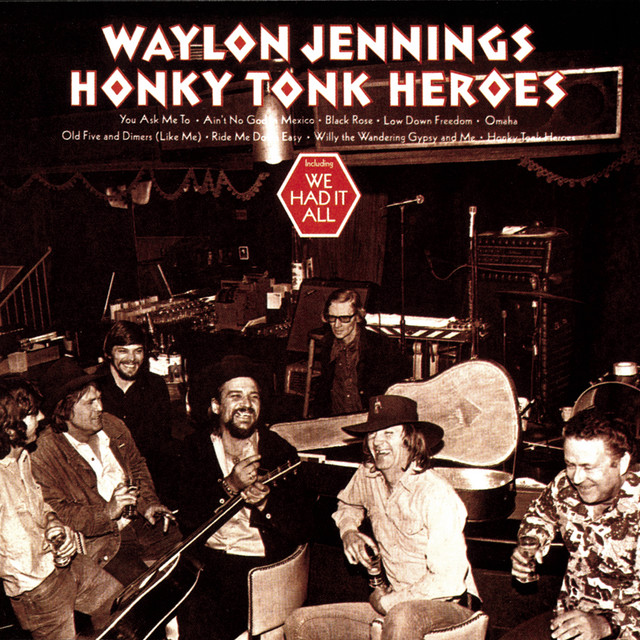
Waylon Jennings is an almost mythical force in the history of outlaw country, a sub-genre that bucked the norms of the Nashville establishment in the early 70’s. Disillusioned with both the artistic and sonic constraints of producers like Chet Atkins who favored slick production over a more organic and natural sound, artists like Jennings and his close friend Willie Nelson rebelled against the status quo to great success. Along with wrestling back creative control of their art (during that time the record labels has exclusive rights as to what songs were to be recorded and released on country albums) as well as having input into which studio musicians would play on their albums (same story here, the record labels used to dictate which musicians did studio work), Jennings and his brotherhood found great commercial success in carving out their niche. Put another way, they fought the establishment and won every step along the way.
Honky Tonk Heroes is a seminal album of the genre, and is largely considered one of the sparks that lit the flame for outlaw country to become an en vogue counterpoint to the mainstream music of the day. Jennings’ voice– his delivery slightly strained to the limits of his range but never off pitch, the passion in his voice measured but never manic, his backing band The Wayloners providing tight harmonies that hug his lead lines– is a defining characteristic of what makes outlaw country so great.
And the ideals of creative freedom that formed the basis of the genre is the only reason this album got made.
At Willie Nelson’s annual Fourth of July Picnic in 1972 Jennings met an unheralded (at that time) songwriter named Billy Joe Shaver. Shaver was playing some of his original songs and an impressed (and likely inebriated) Jennings invited him down to Nashville to record a full album of “them ol’ cowboy songs.” Like any good cowboy story it gets a little wild from there– Jennings dodged Shaver for a whole six months but Shaver traveled to Nashville on his own dime to track him down, confronting a bewildered Jennings at an RCA recording session where he said he was willing to fight him if he didn’t listen to his songs.
After Jennings agreed to record “Willy the Wandering Gypsy and Me” for his upcoming album he laid out the terms of their future agreement– Shaver would keep on playing songs right then and there, and if Jennings liked the song he would record it. However, if he didn’t like the next song Shaver would have to leave the studio never to work with Jennings again. In succession Shaver belted out “Ain’t No God in Mexico”, “Honky Tonk Heroes”, and finally “Old Five Dimers (Like Me)” and Jennings signed him on the spot. Producer Chet Atkins objected strongly to this haphazard arrangement, but since Jennings had negotiated creative control, Atkins was overruled. Every single song on the album besides one was written by Billy Joe Shaver.
The rest was history. It’s a bit surreal to listen to Honky Tonk Heroes 50 years later with this context because when I think of what classic country sounds like in my head, and then a track like “Low Down Freedom” hits my eardrums, it’s the exact same sound. In 1973 Honky Tonk Heroes may have been a radical departure from the mainstream, but in 2023 it’s lasting power is abundantly clear.
Standout Songs: “Black Rose”, “We Had It All”, “Old Five and Dimers (Like Me)”