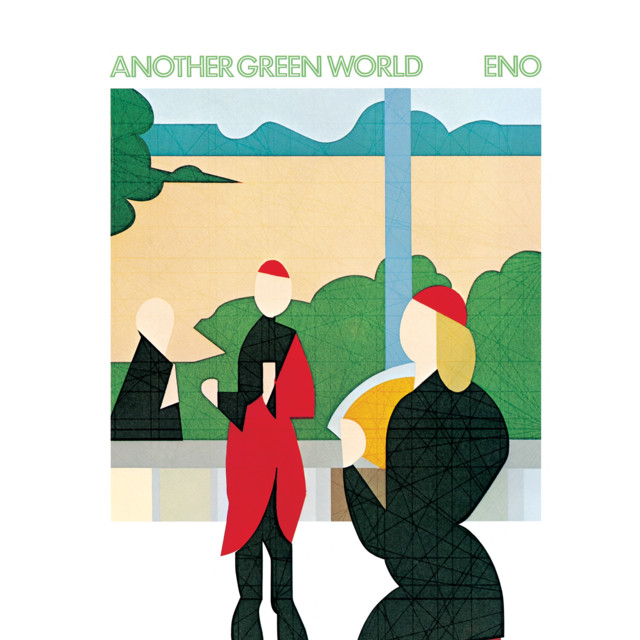
Another Green World by Brian Eno is an eclectic collection of avant-garde pop vignettes. Calling them songs doesn’t really do the whole thing justice— these are emotions in audio form, a collection of feelings that were somehow transposed into music through the filter of Brian Eno’s astounding production capabilities.
It’s often hard to listen to art rock for 40 minutes straight without zoning out (by nature it typically encourages that sort of behavior), but I found myself in active listening mode throughout the entirety of the experience. And the word “experience” is used purposefully here— there aren’t too many albums like Another Green World that diverge so deep into the space of avant-garde while still retaining the gravitational pull of pop music. Another Green World is a distant planet in the solar system, imperceptible to the human eye, but manages to dutifully make its way slowly around the sun.
One reason it works so well is the sheer talent Eno had in the studio with him. With players like Robert Fripp (guitar), Phil Collins (drums), Percy Jones (fretless bass), Rod Melvin (piano), and John Cale of The Velvet Underground (viola) lending their talents during the recording process, it naturally becomes a bit easier to thread the needle between self indulgence and general appeal. Brian Eno certainly threaded that needle.
Outside of the immense experimentation in production (see the liner credits which reference instruments like “snake guitar”, “uncertain piano”, and “spasmodic percussion”), one technique Eno became famous for was his use of Oblique Strategies during a free-form recording process like this. The whole Wikipedia article is worth a read, but the headline here is that each player would be handed 2.8×3.5 inch card that contained a challenging constraint they must adhere to while playing a particular section. These include prompts like “What would your closest friend do?”, “State the problem in words as clearly as possible”, and “Ask your body” that musicians had to translate through their instruments. It’s goal was to break creative blocks by encouraging lateral thinking and approaching sections in an entirely new way of thinking.
Mission accomplished.
Standout Songs: “Sky Saw”, “St. Elmo’s Fire”, “Becalmed”, “The Big Ship”